Development and Expansion of Environmental Contribution Products
Environmental Contribution Products
To produce chemical and industrial products, we use natural resources, emit CO2, and generate waste, all of which impact the environment. However, considering the entire lifecycle of products from raw material extraction to final product disposal, there are cases where the presence of these chemical and industrial products helps reduce the environmental impact.
The Nippon Shokubai Group’s products are used throughout supply chains as well as in everyday products, the equipment used to produce those products, infrastructure, and elsewhere. Thus, we evaluate how our products contribute to reducing environmental impact.
Our internal certification committee examines checklists, numerical data, and other information to certify Environmental Contribution Products. From FY2022, we have received an annual third-party review prior to examination by the internal certification committee, and have reflected the views and advice obtained from the review in examination materials. Five products were newly certified in FY2025.
Applications in parentheses

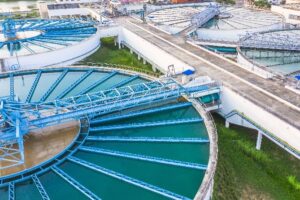


Environmental Contribution Products
Preventing global warming/conserving energy
| Types of contribution | Product life stage | Application | Certified product |
|---|---|---|---|
| Reducing GHG emissions | Manufacturing | Binding agent for fish feed in aquaculture | AQUALIC™ H (for feed) |
| Concrete admixtures | AQUALOC™ | ||
| Multifunctional hydrophilic treatment agent for synthetic fibers | PET-4G* (product using recycled PET) [SINO-JAPAN CHEMICAL CO., LTD.] | ||
| Use | Material for rechargeable lithium-ion batteries | IONEL™ | |
| Solid-state battery materials | ICPDAP™, ICPSEB™ | ||
| CO2 absorbent | Aminoalcohol* (for absorbent) [NIPPON NYUKAZAI CO., LTD.] | ||
| FO (forward osmosis) system components for seawater desalination | Draw solute | ||
| Disposal | Paint, adhesive materials, and reactive diluent | Isobornyl Acrylate | |
| Paint and adhesive materials | Ethyl Acrylate | ||
| Adhesive, Synthetic resin | 2-Octyl Acrylate | ||
| Same as conventional products | ISCC PLUS certified products | ||
| Water and oil repellent, Temperature sensitive adhesive | BeA-N* (Behenyl Acrylate) [NISSHOKU TECHNO FINE CHEMICAL CO., LTD.] | ||
| Detergents, Pesticides, Metal processing oils | SINOPOL* (Products partially made from renewable raw materials) [SINO-JAPAN CHEMICAL CO., LTD.] | ||
| Disinfectants | SINOTEX* (Products partially made from renewable raw materials) [SINO-JAPAN CHEMICAL CO., LTD.] | ||
| Energy conservation | Manufacturing | UV-curable reactive diluents | VEEA™ |
| Use | Material for solid oxide fuel cells | Electrolyte sheets for solid oxide fuel cells | |
| Automotive damping materials | ACRYSET™ (for damping materials) | ||
| Optical and electronic materials | ZIRCOSTAR™ |
Reducing chemical emissions/preserving air quality
| Types of contribution | Product life stage | Application | Certified product |
|---|---|---|---|
| Reducing chemical emissions | Use | Water-based paints | UWR™, ACRYSET™ (for water-based paints) |
| Emulsifier for emulsion polymerization for water-based paints | NEWCOL*1*2 (for emulsion polymerization) [NIPPON NYUKAZAI CO., LTD.] | ||
| SINONATE*1 (for emulsion polymerization) [SINO-JAPAN CHEMICAL CO., LTD.] | |||
| Reactive surfactant*1 (for emulsion polymerization) [SINO-JAPAN CHEMICAL CO., LTD.] | |||
| Water-based adhesives | EPOCROS™ | ||
| UV-curable paints | AOMA™ | ||
| Dispersants for suspension concentrate (SC) agrochemical formulations | SINOCOL AFC*1 [SINO-JAPAN CHEMICAL CO., LTD.] | ||
| Preventing air pollution | Use | Removing hydrocarbons (HC), NOx, dioxins, and other pollutants from exhaust gas | Automotive catalysts |
| Waste gas treatment catalysts | |||
| Denitrification catalysts and equipment | |||
| Dioxin decomposition catalysts and equipment |
*2 “NEWCOL” is the trademark of NIPPON NYUKAZAI CO., LTD.
Conserving water resources/water quality/biodiversity
| Types of contribution | Product life stage | Application | Certified product |
|---|---|---|---|
| Preventing water pollution | Use | Oxidizing/decomposing hazardous substances in wastewater | Wastewater treatment catalysts for catalytic wet air oxidation |
| Water treatment agents | EPOMIN™ | ||
| Polymer flocculants | Aminoalcohol*1 (for flocculants) [NIPPON NYUKAZAI CO., LTD.] | ||
| Fire extinguishing agents | NEWCOL*1*2 (for fire extinguishing agents) [NIPPON NYUKAZAI CO., LTD.] | ||
| Disposal | Detergent builders | AQUALIC™ L (for detergent) | |
| Bio-degradability | Disposal | Detergent ingredients | SOFTANOL™ |
| HIDS™ | |||
| Solvents for detergents and paints | Butyl Di Glycol*1 [NIPPON NYUKAZAI CO., LTD.] | ||
| Solvents for electronic materials and industrial cleaning agents | Methyl Propylene Glycol*1 [NIPPON NYUKAZAI CO., LTD.] |
*2 “NEWCOL” is the trademark of NIPPON NYUKAZAI CO., LTD.
Resource circulation / Waste reduction
| Types of contribution | Product life stage | Application | Certified product |
|---|---|---|---|
| Reducing resource consumption | Use | Hollow fiber membranes | Polyvinylpyrrolidone |
| Waste reduction | Use | Detergent builders | High-performance polymer for cleaning (AQUALIC™ L series SB) |
| Disposal | Concrete admixtures | AQUAGUARD™ | |
| Waterproofing materials | HAL e‑COAT* [EMULSION TECHNOLOGY CO., LTD.] |
Promoting the Reduction of CO2 Emissions Throughout the Entire Lifecycle of Products
Among the Environmental Contribution Products of the Nippon Shokubai Group, we evaluate those that make a particularly significant contribution to reducing CO2 emissions using the Carbon Life Cycle Assessment (cLCA) methodology.
cLCA is an evaluation method that compares the life cycle CO2 emissions of a finished product that uses a specific chemical product with those of a comparable finished product that uses an alternative product. The difference in life cycle CO2 emissions between the two is regarded as the additional emissions that would occur in the absence of the specific chemical product and is quantified as the product’s contribution to CO2 emissions reductions.
The evaluation results represent potential CO2 emissions reductions estimated under specific assumptions. They should not be interpreted as actual CO2 emissions reductions achieved across society or as avoided emissions attributable to our actual sales volumes.
Products expected to contribute to reducing CO2 emissions
IONEL™
ICPDAP™
ICPSEB™
Electrolyte
sheets for solid
oxide fuel cells
Total: 5.96 million tons*1
- (1) Potential CO2 emissions reductions if batteries were utilized as balancing power sources for the use of renewable electricity supplied in one year (excluding electric vehicle and other transportation applications)
- (2) Potential CO2 emissions reductions from fuel cells
IONEL™ and ICPDAP™/ICPSEB™ are used in storage batteries, which are expected to be used as regulating power sources to boost solar and wind power, which are the main sources of renewable energy but are characterized by widely fluctuating output. Additionally, solid oxide fuel cells are highly efficient at supplying power and heating water, contributing to reducing CO2 emissions.
- Assessment prerequisites
The CO2 reduction from using storage batteries is attributable to its regulation of fluctuations in power output for optimal economic efficiency in balancing supply and demand for electricity.
Because future hydrogen supply cannot be reliably forecast, the fuel-cell assessment is based on residential fuel cells that generate electricity by reforming city gas. The comparison baseline is thermal power generation.
Aminoalcohol (for absorbent)
[Nippon Nyukazai Co., Ltd.]*2
5.5 million tons*3
- Potential CO2 emissions reductions if CO2 emitted from thermal power plants in Japan over one year were captured and stored using chemical absorption technology
While renewable energy is increasingly being used, thermal power plants continue to operate to achieve stable power supply. Aminoalcohol contributes to CO2 emissions reduction because this product is used when these power plants trap CO2 from waste gas through a chemical absorption technique.
- A product of our Group company.
- Assessment prerequisites
Aminoalcohol was used as an absorbing solution when CO2 was separated and collected, and the amount of energy required mainly for the separation and collection was evaluated. The comparison target was CO2 emissions without the separation or collection.
AQUAGUARD™
4.05 million tons*4
- Calculation of CO2 emissions avoided in one year when all apartments are built as long-lasting structures
We developed AQUAGUARD™ to limit cracking in concrete. Combining AQUAGUARD™ with high-performance AE water reducer should substantially prolong the useful lives of concrete structures.
- Assessment prerequisites
Potential CO2 emissions reductions if all multi-unit residential buildings constructed in one year were built as long-life residential buildings. Service life was assumed to be 100 years for long-life multi-unit residential buildings and 50 years for conventional multi-unit residential buildings. CO2 emissions associated with the construction, operation, and disposal of the residential buildings were evaluated in accordance with the Guidelines for Life Cycle Assessment of Buildings published by the Architectural Institute of Japan (AIJ).
VEEA™
330,000 tons*5
- Potential CO2 emissions reductions from all UV-curable inks produced in one year
Using VEEA™ as a UV-curing reactive diluent in eco-friendly ink removes the need to use volatile solvents and the equipment associated with them, saving energy and improving productivity.
- Assessment prerequisites
The evaluation assumes four-color printing on a full-size A-series printing sheet (0.55 m² per sheet), with an ink consumption of 3.2 g/m². The assessment was conducted by comparing a commercially available offset printing press with a commercially available UV printing press.
ACRYSET™
(for damping materials)
310,000 tons*6
- Potential CO2 emissions reductions if coating-type vibration damping material were applied to all automobiles produced in one year
We developed an emulsion for vibration-damping coating to be applied to the lower surface of a vehicle body to suppress vibrations and noise from engines and road surfaces. Using vibration-damping coating should make automobiles lighter and conserve fuel.
- Assessment prerequisites
Vehicles to be driven 10,000 km per year for 10 years. Compared to vehicles with asphalt sheet as the vibration-damping material.
ZIRCOSTAR™
220,000 tons*7
- Potential CO2 emissions reductions if Zircostar™ were used in all smartphones produced in one year
With its high optical properties, this product can be used as an optical material for plastic lenses, displays, and other components of mobile phones and smartphones, helping conserve the energy consumed by the displays of the devices and lengthen the battery life.
- Assessment prerequisites
According to the usage time described in the Carbon Footprint Product Category Rules, the product was evaluated as being in use for two years. A smartphone incorporating ZIRCOSTAR™ in the optical material was evaluated as achieving a 3.6% reduction in power consumption as an energy-efficiency benefit.
AQUALIC™ H (for feed)
80,000 tons*8
- Calculation of CO2 emissions avoided when all aquaculture feed produced in one year is replaced with moist pellets (MP)
With AQUALIC™ H as its binding agent, MP contains less fish meal—an ingredient that requires a lot of energy to source and dry—than dry pellets, helping reduce CO2 emissions in aquaculture business.
- Assessment prerequisites
Potential CO2 emissions reductions if all fish feed produced in one year for aquaculture were replaced with moist pellets (MP). MP, which uses AQUALIC® H as a binder, contributes to CO2 emissions reductions in aquaculture because it contains less fishmeal than conventional dry pellets. Since fishmeal production requires substantial energy for raw material procurement and drying processes, reducing its use helps lower CO2 emissions.
Note: The assumptions described above are provided for estimation purposes only and do not guarantee actual service life or performance.