Sustainability Management / Materiality
Our Group Mission at Nippon Shokubai Group, “TechnoAmenity: Providing prosperity and comfort to people and society, with our unique technology,” expresses our desire to contribute to creating a society where people can not only enjoy economic and material affluence but also lead a comfortable life with social and emotional well-being along with hope for the future.
Our business activities are supported by society and the rich global environment that sustains it, and achieving sustainability is a crucial challenge for Nippon Shokubai Group.
We believe that it is our mission not only to reduce the environmental impact of our business activities but also to provide solutions to various social issues through our technology, thereby contributing to the realization of a sustainable society.
Such initiatives create new economic value and increase corporate value. We aim to achieve sustainability and growth through our business and technology.
Sustainability Policy
This Policy has been approved by the Sustainability Promotion Committee (which is chaired by the President and composed of Inside Directors of the Board, Executive Officers and others appointed by the President).
Based on our Group Mission “TechnoAmenity: Providing prosperity and comfort to people and society, with our unique technology,” the Nippon Shokubai Group strives to realize a sustainable society and increase corporate value, by engaging in dialogue with stakeholders and conducting business activities with fairness and integrity.
- We will solve social issues through our business activities and contribute to the future of people and society.
- We will protect the global environment and build a society where future generations can live with peace of mind.
- We aim to be a continually growing organization where diverse talents can be active.
Management System for promoting sustainability
Sustainability Promotion Committee chaired by the president has been organized to implement sustainability initiatives.
| Board of Directors | ||||||
Report  |  | Supervise | ||||
| Sustainability Promotion Committee | ||||||
| Chair: Members: Secretariat: | President Inside Directors of the Board, Executive Officers and others appointed by the President General Affairs & HR Division | |||||
Report |  Direction Direction | (Sustainability issues addressed across departments) | ||||
| Subcommittee | ||||||
| Administration & Finance, Sales & Marketing, Innovation & Business Development, Production and Technology, RC | ||||||
Roles of Sustainability Promotion Committee
- Determine Group’s policies and strategies relating to promote sustainability initiatives
- Direct each department to formulate plans and measures and evaluate their performance and progress
- Consider other significant matters relating to promote sustainability initiatives
- Disseminate information about the initiatives to stakeholders
Operation for Sustainability Promotion Committee
- In principle, the Committee meets at least twice a year.
- When it is necessary to consider and adopt measures for important sustainability issues across departments, the Committee will establish a subcommittee to assume responsibility for them.
Materiality
The Nippon Shokubai Group has formulated a long-term vision called “TechnoAmenity for the Future” and is promoting three transformations—”Business Transformation,” “Strategic Transformation for Environmental Initiatives,” and “Organizational Transformation”—towards the goal for FY2030. In conjunction with the formulation of our Mid-term Management Plan, we have identified materiality and revised its content to align with the three transformations. Moving forward, we will manage the progress of materiality and implement the PDCA cycle to achieve the realization of a sustainable society and increase corporate value as outlined in our Sustainability Policy.
Contribution to people and society
Contribute to the future of people and society by solving social issues through our business activities
Materiality 1. Contribution to solving social issues
Relevant SDGs :
Continuous creation of new products
| Vision | A company with the technology and talent to continuously create products that contribute to people and society |
|---|---|
| Initiatives | ・Strengthening the R&D capabilities ・Strengthening the constitution of R&D organization ・Investment in R&D human capital |
| KPI / Ideal state | ・Swiftly develop customer-oriented materials and solutions and contribute to the realization of a sustainable society ・Possess, acquire, and continuously advance world-class core technologies to ensure competitiveness in target markets ・Actively exchange information with people inside and outside the company to engage in collaboration that sparks innovation (achievement year: each by FY2030) |
| Actual performance in FY2025 | ・Implemented smart laboratory initiatives in phases. ・Advanced new materials to the next stage of development. ・Secured selection for a NEDO project through collaboration with external partners and promoted the development of DX talent within the Company. |
Promotion of the development and sales of Environmental Contribution Products
| Vision | A company that creates products contributing to the reduction of environmental impact |
|---|---|
| Initiatives | Promotion of the Solutions Business |
| KPI / Ideal state | Revenue from Environmental Contribution Products: ・55 billion yen (FY2027) ・135 billion yen (FY2030) |
| Actual performance in FY2025 | 44 billion yen |
Promotion of environmental initiatives
Protect the global environment and build a society where future generations can live with peace of mind
Materiality 2. Promotion of environmental initiatives
Relevant SDGs :
Contribution to achieving carbon neutrality
| Vision | Achieving net zero for Scopes 1 and 2 by FY2050 |
|---|---|
| Initiatives | ・Promoting the use of bio-based materials ・Promoting energy conservation ・Promoting the use of green energy ・Process improvement ・Improving catalyst efficiency |
| KPI / Ideal state | Greenhouse gas (GHG) emissions: 30%* 1 reduction in emissions by FY2030 from the base year as Nippon Shokubai Group total (achievement year: each by FY2030) |
| Actual performance in FY2025 | 24.5% reduction*2 |
- (In Japan) 30% reduction from FY2014 levels
(Outside Japan) Reduction by [reduction objectives for each company] from [base year for each company] levels - Includes an offset of 58 thousand metric tons of CO2 through carbon credits associated with the introduction of carbon-offset city gas, equivalent to 4.5% of base-year emissions.
Reduction of Product Carbon Footprint (PCF)
| Vision | Contributing to the reduction of GHG emissions throughout the supply chain |
|---|---|
| Initiatives | ・Enhancing product carbon footprint data quality ・Sharing PCF information with stakeholders |
| KPI / Ideal state | Continuous improving calculation accuracy and reducing GHG emissions for each product through ongoing activities (achievement year: by FY2027) |
| Actual performance in FY2025 | Increased the proportion of primary data through collaboration with suppliers, thereby improving calculation accuracy and contributing to the reduction of GHG emissions for the products. |
Conservation and efficient use of water resources
| Vision | Maintaining harmony between water resource security and water use in business activities |
|---|---|
| Initiatives | Risk assessment and promotion of efficient use of water resources |
| KPI / Ideal state | Continuous monitoring of water risks (stress) and actions based on assessment results (achievement year: by FY2027) |
| Actual performance in FY2025 | Reassessed water-related risks, including those at Group companies added in FY2025, and confirmed that the oveall risk status remained unchanged. |
Contribution to resource recycling
| Vision | Minimizing waste generation and effectively utilizing it as resources and energy | |
|---|---|---|
| Initiatives | ・Waste reduction ・Promotion of recycling | |
| KPI / Ideal state | (1) (2) | Quantity of final off-site landfills: maintaining zero emissions*1 (achievement year for Nippon Shokubai alone: by FY2027) Waste plastic emissions: 50% reduction in emissions from FY2021 level (achievement year for Nippon Shokubai alone: by FY2030) |
| Actual performance in FY2025 | (1) (2) | Maintained zero emissions. 49% reduction from FY2021 level |
- (Quantity of final off-site landfill) ≤ (total amount of waste generated x 0.1%)
Strengthening the company’s foundation and achieving sustainable growth
Aim to be a continually growing organization where diverse talents can be active
Materiality 3. Developing / Promoting the active participation of talent
Relevant SDGs :
Development of autonomous talent
| Vision | Employees resonating with the company’s vision, finding their work fulfilling, growing together with the company, and trusting each other | |
|---|---|---|
| Initiatives | ・Provision of learning opportunities ・Implementation of the preferred career declaration system | |
| KPI / Ideal state | (1) (2) (3) | Participant ratio of self-selected training programs (e-learning, skill development training, online English conversation classes, etc.): Maintain 70% or above Continue to implement career training (second career training, promoting women’s participation and advancement in workplaces, training for young employees and others) according to hierarchical levels Continue to implement interviews between supervisors and subordinates through the career declaration system (achievement year for Nippon Shokubai alone: each by FY2027) |
| Actual performance in FY2025 | (1) (2) (3) | 143.4% Continued implementation. Continued implementation. |
Promote the active participation of diverse talent
| Vision | Employees resonating with the company’s vision, finding their work fulfilling, growing together with the company, and trusting each other | |
|---|---|---|
| Initiatives | Establishment and maintenance of the working environment | |
| KPI / Ideal state | (1) (2) (3) (4) | Increase the positive response rate for D&I-related items in the employee survey: 80% or above Ratio of female employees hired in the clerical and chemical position: 30% or above Improve ratio of female managers (managerial positions): 8% or above Ratio of male employees taking childcare leave (15 days or more): 100% (achievement year for Nippon Shokubai alone: each by FY2027) |
| Actual performance in FY2025 | (1) (2) (3) (4) | 70.6% 27.3% 7.0% 95.3% |
Materiality 4. Promotion of CSR in the value chain
Relevant SDGs :
Strengthening supply chain management
| Vision | Building a sustainable supply chain that not only complies with laws and regulations, but also takes human rights and the global environment into consideration |
|---|---|
| Initiatives | Enhancing supplier survey content and maintaining coverage rate |
| KPI / Ideal state | CSR supplier survey coverage rate (based on raw material purchase amount): Maintain 95% or above (achievement year for Nippon Shokubai alone: by FY2027) |
| Actual performance in FY2025 | Conducted CSR supplier surveys covering suppliers representing 95% of raw material purchase value. |
Strengthening efforts to respect human rights
| Vision | Widely adopting and firmly establishing efforts to respect human rights, which is required internationally |
|---|---|
| Initiatives | Establishment of human rights due diligence process |
| KPI / Ideal state | Human rights due diligence: Starting implementation across the entire Group (achievement year: by FY2027) |
| Actual performance in FY2025 | Started implementation of human rights due diligence for consolidated subsidiaries. |
Materiality 5. Strengthening governance
Relevant SDGs :
Enhancing compliance awareness
| Vision | Contributing to enhancing corporate value, while fulfilling our corporate social responsibilities, such as compliance, as a result of Group Mission Framework being well understood and practiced by the executives and employees | |
|---|---|---|
| Initiatives | ・Dissemination of Group Mission Framework ・Promotion of the practice of Code of Conduct | |
| KPI / Ideal state | (1) (2) | Participant ratio of compliance training (by hierarchical level): Maintain 95% or above (achievement year for Nippon Shokubai and Group Companies in Japan: by FY2027) Number of significant violations of laws or regulations in the social and economic area: Maintain 0 (achievement year for Nippon Shokubai alone: by FY2027) |
| Actual performance in FY2025 | (1) (2) | 95% or higher 0 |
Enhancing the effectiveness of the Board of Directors through the exercise of its roles and demonstration of its functions
| Vision | Effectively fulfilling responsibilities as a strategic formation function of our Group, in addition to the decision-making and supervisory functions of business execution |
|---|---|
| Initiatives | Continuous implementation of the evaluation of the effectiveness of the Board of Directors |
| KPI / Ideal state | ・Review and fulfill the necessary skills and attributes of the Board of Directors ・Continue to implement the evaluation of the effectiveness of the Board of Directors and address key issues based on the survey results (achievement year for Nippon Shokubai alone: each by FY2027) |
| Actual performance in FY2025 | ・Continued discussions on the necessary skills and attributes of the Board of Directors Meeting therein. ・Conducted the evaluation of effectiveness of the Board of Directors by the independent third-party evaluator, and continued to address the identified issues. For details, please refer to the Corporate Governance Report. |
Strengthening medium- to long-term incentives for executives
| Vision | Making swift and decisive decisions for sustainable growth |
|---|---|
| Initiatives | ・Promotion of initiatives in accordance with the Corporate Governance Code ・Review of the executive compensation system |
| KPI / Ideal state | Consider and complete expanding the proportion of performance-linked and stock-based remuneration for executives (achievement year for Nippon Shokubai alone: each by FY2027) |
| Actual performance in FY2025 | Introduced an executive compensation system with an increased proportion of performance-linked and stock-based remuneration. |
Materiality 6. Promotion of safe and stable production activities
Relevant SDGs :
Safety culture development / Strengthening safety infrastructure
| Vision | Continuing safe and stable production regardless of changes in the business environment, ensuring customer satisfaction and trust | |
|---|---|---|
| Initiatives | Promotion of the Medium-term RC Basic Plan | |
| KPI / Ideal state | (1) (2) | Class 1 and Class 2 process safety accidents*1: 0 Serious injuries*2: 0, injuries with lost workdays: 0 (achievement year: each by FY2027) |
| Actual performance in FY2025 | (1) (2) | Class 1 process safety accidents: 0 Class 2 process safety accidents: 1 Serious occupational injuries: 0 Lost-time injuries: 2 |
- Class 1 process safety accident: Severity point is 18 or more according to CCPS/Japan Petrochemical Industry Association, or fatal accident.
Class 2 process safety accident: Severity point is 1 or more but less than 18 according to CCPS/Japan Petrochemical Industry Association. - Resulting in injuries with 4 or more lost workdays, or disability class from 1 to 14
according to Industrial Accident Compensation Insurance Act Enforcement Ordinance Appendix Table 1 Disability Class Table
Improvement of product quality and trust
| Vision | Continuing safe and stable production regardless of changes in the business environment, ensuring customer satisfaction and trust |
|---|---|
| Initiatives | Promotion of the Medium-term RC Basic Plan |
| KPI / Ideal state | Serious quality complaints: 0 (achievement year: by FY2027) |
| Actual performance in FY2025 | 0 |
Materiality Identification Process
In formulating the Mid-term Management Plan 2027, the Nippon Shokubai Group conducted a review through the following process in FY2024.
Based on changes in social conditions and the business environment, we conducted cross-company discussions and identified the following items as social issues and changes closely related to our group.
| Environment | Social | Economy |
|---|---|---|
| – Climate change issues – Water resources / Biodiversity | – Achieving safety and security life / long healthy life – Global population growth – Domestic aging population – Diversification of needs – Increasing awareness of human rights | – Growing economies of emerging countries – Advancements in digital technology – Increasing importance of information security – Growing demand for new materials supporting technological development |
In addition to the aforementioned social issues and changes, we conducted a more extensive review than in the previous materiality identification, referencing the following items, and comprehensively identified sustainability-related issues.
- International guidelines and disclosure standards (The Ten Principles of the UN Global Compact, GRI Standards, SASB, CSRD, ISSB, etc.)
- Evaluation criteria of ESG rating agencies(FTSE, S&P CSA, MSCI, etc.)
- Materiality identified in FY2021
- Discussions on the Mid-Term Management Plan 2027
- Opinions from internal and external stakeholders (institutional investors, employees, etc.)
- Discussions in the Risk Management Committee
- CSR supplier survey and Supply Chain Ethical Information Sharing Platform (Sedex, EcoVadis)
- SDGs (Sustainable Development Goals)
We evaluated each identified issue from two perspectives: its importance to stakeholders and its importance to our Group. We then prioritized these issues. For the high-priority issues, we held discussions with relevant departments and selected materiality and candidates for its corresponding individual elements.
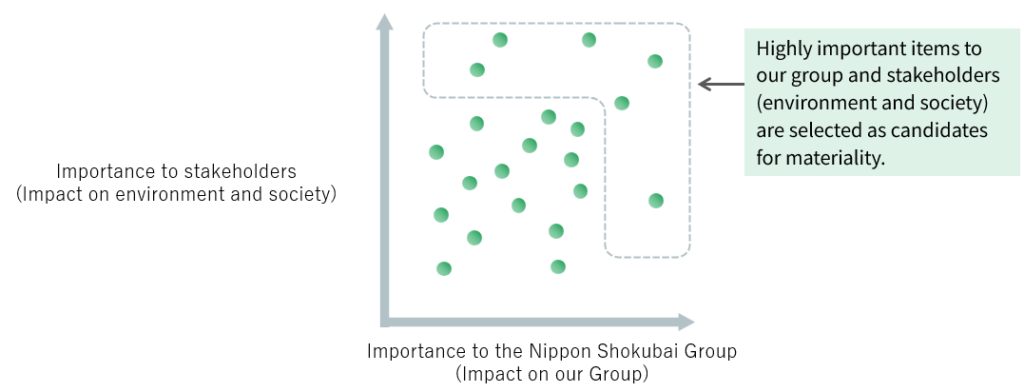
These candidates were discussed by the Sustainability Promotion Committee, identified and approved as six items of materiality and fifteen individual elements, and reported to the Board of Directors.
We will promote materiality initiatives by managing the progress of KPIs set for each individual element by the Sustainability Promotion Committee.
Click here for Materiality and Identification Process for FY2022-2024