Resource Circulation / Waste Reduction
Nippon Shokubai Group has established the following statements in its Environmental Protection Policy: “Reduce emissions of waste and chemical substances, and promote the recycling and effective use of resources including water resources to contribute to the realization of a Sound Material-Cycle Society.” “Actively seek to develop and provide products and technologies that help reduce environmental impact.” Based on this policy, we are systematically promoting resource circulation and waste reduction.
Specifically, we are steadily working toward our objectives of reducing the quantity of waste sent to off-site landfills for disposal under our “Zero Emissions” initiative and reducing the quantity of plastic waste sent for external treatment. In addition, we are collecting, monitoring, and managing data on waste quantities and recycling quantities from each production site within the Group, and are implementing thorough waste separation education to promote effective resource utilization.
Efforts Toward Compliance with the Act on Promotion of Resource Circulation for Plastics
Nippon Shokubai is working to promote the reduction and recycling of industrial waste from plastic-containing products. Under the Medium-term RC Basic Plan 2027, we have set a target to reduce the quantity of waste plastics outsourced for external processing by 50% by FY2030, using the FY2021 level (2,893 tons) as the baseline.
In FY2025, the quantity of waste plastic outsourced for external processing was reduced to 1,487 tons, a 49% decrease compared to FY2021. This reduction was achieved through efforts to minimize waste generation during production and to promote material recycling of waste resins and plastic pallets.
We will continue to reduce plastic waste generation and promote resource recovery through chemical and material recycling.
Reducing the Quantity of Waste Sent to Off-site Landfills for Disposal
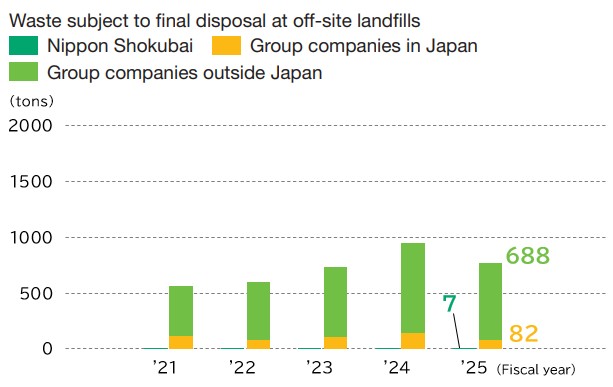
Waste reduction is an important component of efforts to create a sound material-cycle society. Nippon Shokubai sorts, collects, and recycles waste in addition to making other efforts consistent with our goal of achieving and maintaining zero emissions (quantity of waste sent to off-site landfills for disposal is 0.1% or less of the total quantity of waste).
In FY2025, in addition to continuing to rigorously sort and collect waste and promote recycling, we reduced the quantity of waste sent to off-site landfills for disposal and maintained zero emissions by improving processes such that they produce less waste, reusing by-products, and treating product residues on-site.
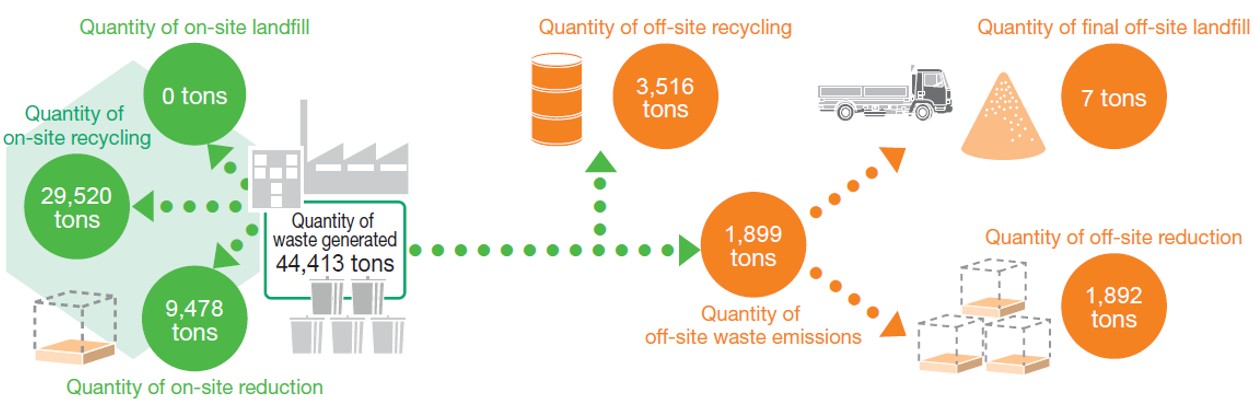
Diagram of Waste Treatment
Group Data
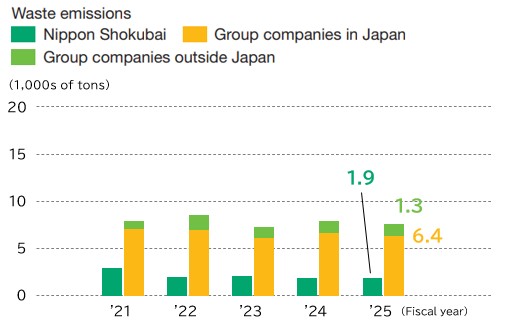
Trends in the Volume of Waste Generated
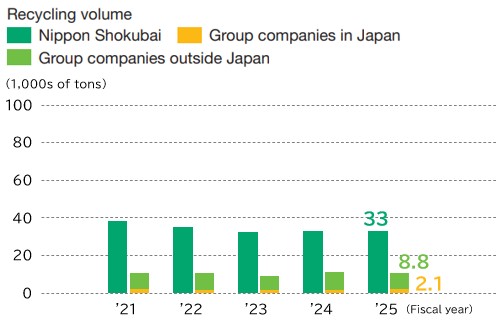
Trends in the Volume of Recycling
Trends in the Volume of Waste Sent to Off-site Landfills for Disposal
Employee’s Voice
Promoting Resource Circulation and Waste Reduction through the Effective Utilization of Waste SAP
I am responsible for improving the manufacturing process and investigating new production technologies for superabsorbent polymer (SAP). In the SAP manufacturing process, waste SAP with different shapes and properties is generated during polymerization and crushing, and much of it had previously been disposed of as waste. In response to the need to reduce disposal-related costs and environmental impact, I worked on investigating ways to reduce SAP disposal.
To reduce SAP disposal, we first focused on both suppressing its generation and implementing equipment-based measures; however, all feasible options had already been exhausted, and some SAP still had to be discarded. Accordingly, as a way of addressing the remaining SAP disposal, we moved forward with efforts focused on reusing waste SAP as a resource.
At our company, we previously sold selected types of waste SAP that are relatively easy to handle to sludge solidification companies, where they are used as a solidifying agent to improve the handling of high‑moisture sludge. Building on this experience, we examined whether SAP with different shapes and properties, which had previously been discarded, could also be utilized through the same approach.
In addition to organizing the characteristics of the waste SAP and verifying whether it could be reused, I was also responsible for coordinating with the receiving party and the intermediary. In particular, even gelled and hardened waste SAP had to be properly dispersed in sludge to ensure stable solidification, so we conducted on-site testing and repeated trial and error. I also focused on consolidating sorting categories and simplifying operational rules so that the burden of sorting waste SAP would not increase for workers at the SAP manufacturing site.
As a result of these efforts, we reduced waste SAP generated in the manufacturing process by about 60%, cutting the annual amount of waste plastic by approximately 600 tons. In addition, by selling waste SAP that had previously been discarded, we also helped reduce waste disposal costs. Going forward, I will continue pursuing practical, site-based improvements and contribute to resource circulation and waste reduction toward the realization of a sound material-cycle society.

Superabsorbents Production
Department
Himeji Plant