Supply Chain Management
Basic Approach to Sustainable Procurement
In our supply chain, from the procurement of raw materials to the manufacture, sale, use, and disposal of products, we are promoting various sustainable procurement initiatives with the aim of putting into practice our Group Mission “TechnoAmenity: Providing prosperity and comfort to people and society, with our unique technology.”
Sustainable Procurement Policy
This Policy has been approved by the Sustainability Promotion Committee (which is chaired by the President and composed of Inside Directors of the Board, Executive Officers and others appointed by the President).
The Nippon Shokubai Group recognizes our suppliers as important partners, and we will build a relationship of mutual understanding and trust with them. We will also conduct fair and impartial business transactions in compliance with laws and regulations and with high ethical standards for the sustainable development of both parties.
With the cooperation of our suppliers, we will also promote sustainable procurement initiatives that take human rights and environmental preservation into consideration.
CSR Procurement Guidelines
The Nippon Shokubai Group are committed to sustainable procurement to fulfill our social responsibility throughout the supply chain. We strongly believe that the understanding and cooperation of our suppliers are indispensable in promoting such efforts. Based on this belief, we have compiled a set of CSR Procurement Guidelines that we invite our suppliers to collaborate on with our Group companies. These guidelines are published on our corporate website and distributed during our CSR supplier survey. We kindly request our suppliers to provide a written confirmation of their agreement with the guidelines. We also encourage our business partners to understand these guidelines and take appropriate actions.
NIPPON SHOKUBAI Group CSR Procurement Guidelines
Management Structure
Nippon Shokubai Group’s sustainable procurement activities are overseen by the Sustainability Promotion Committee, which is composed of the president, directors, and executive officers, who deliberate and decide on policies and measures and report the results to the Board of Directors as necessary.
The Purchasing & Logistics Division and the Sustainability Planning Office will collaborate with other relevant departments to implement measures and carry out daily operations.
Initiatives
Conduct of CSR Supplier Survey
To promote sustainable procurement, we have been conducting a CSR questionnaire survey every two years since FY2021, targeting major suppliers. This survey utilizes the “CSR Procurement Self-Assessment Questionnaire” developed by the Global Compact Network Japan (GCNJ). By responding to the survey, we verify whether their business activities align with our “CSR Procurement Guidelines.” For suppliers whose responses do not meet our standards, we conduct follow-up interviews to assess the current status and provide support for improvement.
In FY2025, we conducted the survey again, targeting significant suppliers accounting for 95% of our raw material purchase value. Based on the revised “Basic Policy on Human Rights” in FY2024, we requested suppliers to respond to a newly introduced “Human Rights Self-Assessment Questionnaire.” In this round of the survey, no suppliers were identified as needing support for improvement. However, based on our standards, we requested some suppliers to further enhance their efforts individually.
We have also begun surveys for new raw material suppliers with whom we have recently started business. We will continue to strengthen collaboration with our suppliers and promote sustainable procurement initiatives.
Green Procurement
Nippon Shokubai promotes initiatives to ensure supplies of safe and reliable products throughout the entire supply chain, from procurement of raw materials to manufacture and sales of products. In accordance with our regulations for green procurement management, we have independently assigned substances that are regulated or highly hazardous to two categories: “prohibited substances” and “restricted substances.” We are promoting the development of green products and the procurement of raw materials with low environmental impact while controlling the inclusion of such substances in our products. For information transmission sheets, we have introduced chemSHERPA.*
- chemSHERPA: This shared system for transmitting information about chemicals contained in products to supply chains was developed under the initiative of the Ministry of Economy, Trade and Industry in Japan. Full-scale utilization began in April 2018.
Responsible Mineral Sourcing Policy
In order to fulfill our corporate social responsibility, we conduct surveys on conflict minerals(*) and promote responsible mineral sourcing. We continuously monitor our suppliers’ practices, and if the use of conflict minerals is identified, we will promptly take corrective measures, including suspension of such materials.
- Conflict minerals such as gold, tantalum, tungsten, tin, cobalt that are mined and sold under conditions associated with conflict and human rights violations in the Democratic Republic of the Congo and its neighboring countries, as well as in conflict-affected and high-risk areas (CAHRAs).
These materials pose risks identified in Annex II of the OECD Due Diligence Guidance, including adverse impacts on the global environment.
Promote Responsible Procurement
We endeavor to steadily respond to human rights, labor practices, health and safety, environment, and Fair Operating Practices in Nippon Shokubai and our group companies, while we also implement a variety of initiatives to ensure responsibility on the supply chain. We utilize Supply Chain Ethical Information Sharing Platforms, such as Sedex*1 and EcoVadis*2, to disclose sustainability information. We have acquired RSPO*3 (Roundtable on Sustainable Palm Oil) certification.
- Sedex is an online platform operated by the non-profit organization Sedex for sharing and reviewing information on ethical and responsible business practices. The platform is utilized across more than 35 industry sectors, including food, agriculture, financial services, apparel, packaging, and chemicals, in 180 countries and regions.
- EcoVadis is an online platform operated by the French company EcoVadis for assessing and managing sustainability performance in supply chains. The platform is used by more than 175,000 companies across over 180 countries and regions.
- RSPO stands for Roundtable on Sustainable Palm Oil, a non-profit organization promoting the sustainable production and use of palm oil.
Logistics Initiatives
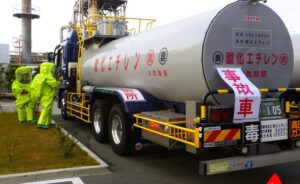
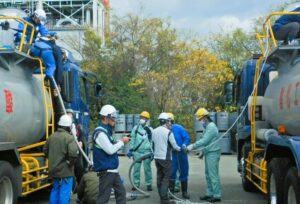
Nippon Shokubai outsources all logistics operations to NISSHOKU BUTSURYU CO., LTD. The company works closely with the environmental safety and quality assurance divisions at the Himeji and Kawasaki Plants to ensure safety and quality and prevent accidents in logistics.
We regularly conduct drills for responding to accidents while products are in transit to make it possible to respond swiftly and minimize the damage in the rare occasions when such accidents occur.
We also endorse the White Logistics movement promoted by the Ministry of Land, Infrastructure, Transport and Tourism and others with the aim of realizing sustainable logistics. We issued our own White Logistics Declaration in April 2020 and have been implementing activities accordingly since then.