Promoting Greenhouse Gas (GHG) Emissions Reduction
Formulating a roadmap for reducing GHG emissions
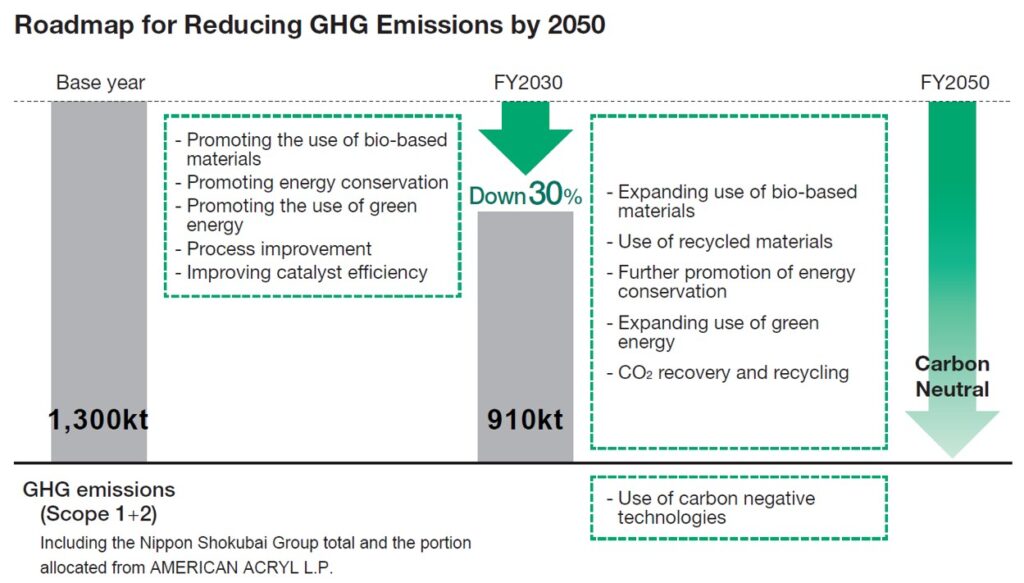
Nippon Shokubai formulated a roadmap for reducing GHG emissions by 2050 in terms of the “strategic transformation for environmental initiatives,” one of the “three transformations” set out in “TechnoAmenity for the future,” the Nippon Shokubai Group long-term vision published in April 2021. In conjunction with the development of the company’s Medium-term Management Plan announced in April 2025, we have identified materiality and newly established Group-wide goals for reducing GHG emissions (Scope 1+2), including those of the group companies outside Japan. By 2030, we will reduce GHG emissions through measures centering on the promotion of energy conservation with manufacturing process improvements, the use of green energy, the partial replacement of raw materials with biomass, and the improvement of catalyst efficiency. From 2030 to 2050, we will promote the above measures and reduce energy-origin GHG emissions by promoting green fuels, such as hydrogen and ammonia. Additionally, we plan to reduce non-energy-origin GHG emissions by expanding the use of biomass and recycled raw materials and by using carbon recycling technology (carbon dioxide capture, utilization, and storage).
Roadmap for Reducing GHG Emissions by 2050
Reducing energy consumption and CO2 emissions
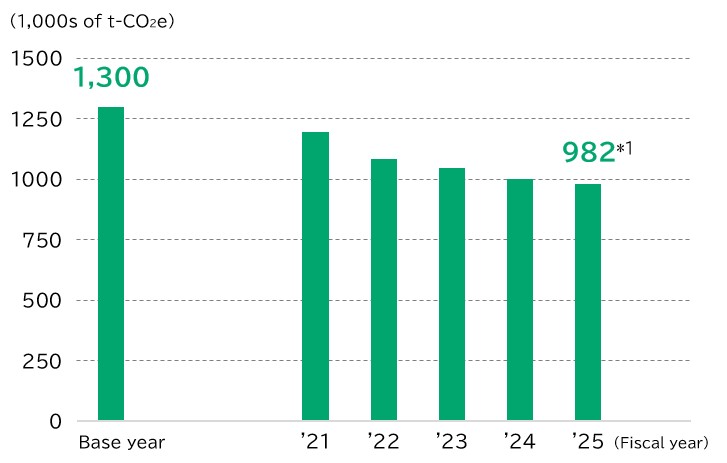
Our RC Promotion Committee, which is chaired by the Company President, formulated a Medium-Term RC Basic Plan based on the targets set out in the action plan of the Japan Chemical Industry Association (JCIA) for achieving a low carbon society. On the basis of this plan, each of our plants takes action to mitigate climate change under the leadership of the committees responsible for promoting energy conservation activities and a reduction in CO2 emissions. In FY2025, energy-saving activities progressed, and the energy consumption intensity improved due to an increase in the production volume of energy generation products. In addition, CO2 emissions decreased as a result of continued use of carbon offset city gas and improvement in CO2 emission intensity. GHG emissions across the Nippon Shokubai Group in FY2025 were 1,040 thousand tons-CO2e. When taking into account the emissions offset by carbon credits associated with the use of carbon offset city gas, GHG emissions were 982 thousand tons-CO2e*1, representing a 24.5%*1 reduction compared to the base fiscal year. Since FY2021, we have been using electricity generated by solar power through an on-site PPA at the Himeji Plant. In FY2025, we also started procuring renewable electricity derived from solar power through an off-site PPA at the Himeji and Kawasaki Plants. In addition, we promote energy conservation activities through the collection of waste heat and the introduction of a co-generation system. We also recover part of the CO2 generated in the manufacturing process and sell it as liquefied carbon dioxide, thereby contributing to its effective utilization. The calculation of GHG emissions and energy consumption for Nippon Shokubai and its Group companies in Japan has undergone third-party verification (see Third-party Verification Report on GHG).
Including a carbon credit offset of 58,000 tons of CO2 emissions (4.5% reduction from the base fiscal year level) due to the purchase of carbon offset city gas.
Trend in GHG Emissions
Employee’s Voice Reducing Steam Consumption in the Production of EO Derivatives
As an operator at a manufacturing site, I am responsible for the operation and analysis of products made using ethylene oxide (EO) as a raw material, known as EO derivatives. In the production process for these EO derivatives, addition reactions of EO are carried out under high-temperature and high-pressure conditions. The initiative I worked on this time was reducing steam consumption in the aging process for the production of a specific EO derivative. In this process, we extended the aging time to reduce EO emissions and switched to an operation designed to leave as little EO as possible. As a result, however, the amount of steam required to maintain the temperature during aging increased. In the early stage of aging, heat generated by the reaction of residual EO must be managed, so the reactor temperature is controlled within a certain range by operating cooling and heating (steam) at the same time. Once the amount of EO remaining falls below a certain level, an energy-saving sequence is activated. This temporarily stops the cooling water pump and steam, after which either steam or the cooling water pump operates depending on the reactor temperature. However, because the pressure gauge used in the sequence also measured trace amounts of N₂ gas contained in the EO, the system often judged that more EO remained than was actually the case. As a result, the energy-saving sequence often did not activate when it should have. Sensing that something was off, I brought the issue to the engineering department and, with their support, identified the cause. Based on a more accurate method for determining the remaining EO amount that removed the effect of N₂ gas from the calculation, I then built a control system incorporating this method. Because production could not be stopped for the modification work, we carried out repeated verification and fine-tuning to ensure there would be no impact on safety or quality, and it took about ten months to complete the improvement.
As a result, while keeping EO emissions low, we lowered steam consumption, resulting in a reduction of approximately 250 tons of CO2 emissions. By applying this improved method for determining the remaining EO amount to similar processes used for other products, I hope to achieve even greater reductions in steam consumption and CO2 emissions. Through this initiative, I once again recognized the importance of treating small signs that something may be off in daily operations as a starting point for improvement. Going forward, I will continue to pursue operations that balance energy saving and reduced environmental impact while always putting safety and quality first.
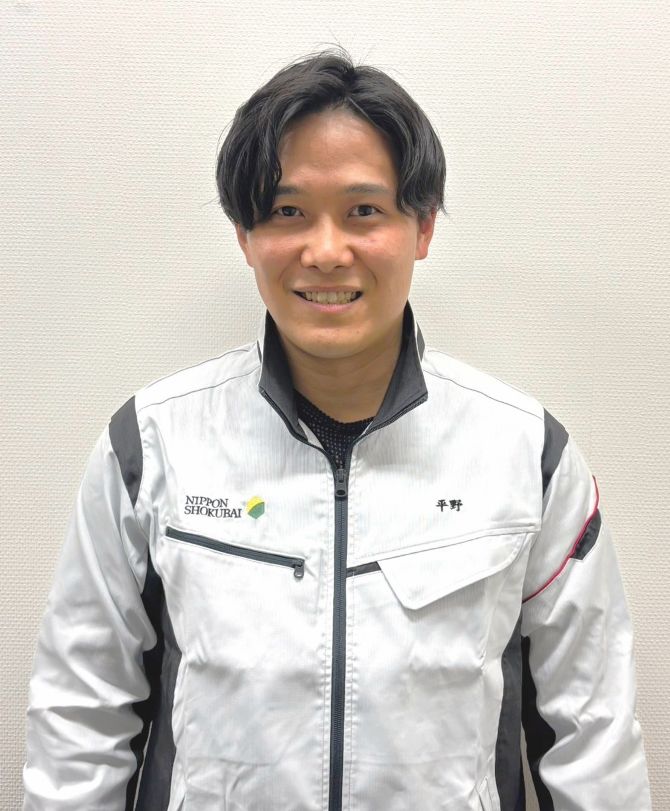
Sota Hirano Production No.4 Section, Kawasaki Plant
Fluorocarbon emission control
The Act on Rational Use and Proper Management of Fluorocarbons, which covers the entire lifecycle of fluorocarbons from production to disposal, went into effect in April 2015, and regulations for disposing of certain equipment were further tightened in April 2020. As a manager of Class I specified products, the Company conducts the legally mandated simple inspections and routine inspections according to plans. Additionally, our calculations of leaked fluorocarbons in FY2025 revealed leakage of 85 t-CO2e from the Himeji Plant, 458 t-CO2e from the Kawasaki Plant, and 546 t-CO2e Company-wide. We intend to make efforts to reduce leaked fluorocarbons—an activity that facilitates climate change mitigation—by intensifying inspections and maintenance, upgrading to equipment that uses refrigerants with low global warming potential and ozone depletion potential, and properly disposing of equipment.
Calculations of Leaked Fluorocarbons in FY2025
(ton-CO2e)
Himeji Plant
Kawasaki Plant
Others
Entire company
85
458
4
546
Promoting Reduction of GHG Emissions Resulting from Our Entire Supply Chain
Calculating Scope 3 emissions
The GHG Protocol classifies GHG emissions into three categories: Scope 1, Scope 2, and Scope 3. Scope 3 is calculated as the sum of GHG emissions associated with business activities across the supply chain, measured for individual categories.
Scope 1
Direct GHG emissions by the reporting company itself (e.g. fuel combustion, industrial process)
Scope 2
Indirect emissions from the use of electricity, heat, or steam supplied by others
Scope 3
Indirect emissions other than Scope 1 and Scope 2 (emissions by others related to the company’s activities)
Nippon Shokubai will continue to calculate Scope 3 emissions and explore the possibility of reducing GHG emissions resulting from all corporate activities.
Trend in Scope 3 Emissions (Data for Nippon Shokubai alone)
(1,000 t-CO2e)
No.
Category
Emissions
FY2023
FY2024
FY2025
1
Purchased goods and services
1,462
1,408
1,381
2
Capital goods
49
88
110
3
Fuel- and energy-related activities not included in Scope 1 or Scope 2
97
95
93
4
Upstream transportation and distribution
14
14
14
5
Waste generated in operations
5
4
5
6
Business travel
0.3
0.3
0.3
7
Employee commuting
0.9
0.9
0.9
12
End-of-life treatment of sold products
1,798
1,811
1,816
Total
3,426
3,421
3,421
Initiatives for the reduction of Scope 3 emissions
In order to contribute to the reduction of Scope 3 emissions, the following items will also be strongly promoted.
Development and expansion of Environmental Contribution Products (products that contribute to the reduction of CO2 emissions when used, etc.)
Development and dissemination of CO2 recovery and recycling technology (carbon recycling technology)
Development and social implementation of material recycling and chemical recycling
Internal Carbon Pricing (ICP)
We have been operating an internal carbon pricing (ICP) system since February 1, 2023, to promote low-carbon and decarbonized management. Through the use of the ICP system, we aim to raise awareness of the Group’s commitment to decarbonization, promote energy conservation, and stimulate consideration of business opportunities and risks related to CO2 emissions reduction. This system will accelerate “Strategic Transformation for Environmental Initiatives,” one of the “three transformations” set forth in our long-term vision.
Outline of the ICP system
Internal Carbon Price
10,000 yen/t-CO2 Shadow price set with reference to domestic and international carbon market prices.
Application method
Changes in CO2 emissions are converted into monetary values using the internal carbon price and applied as one of the evaluation criteria for investment decision-making.
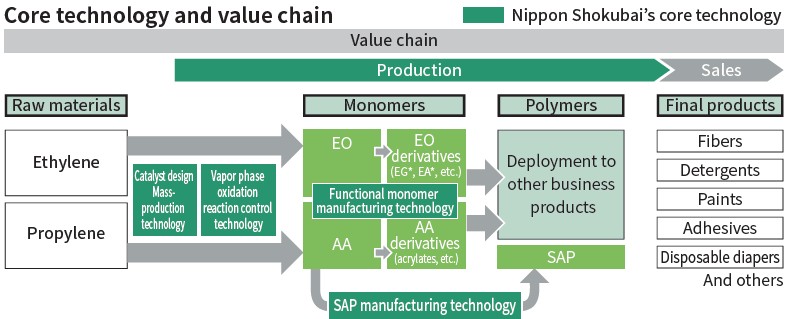
The product names in this text are written using the abbreviations below. AA: Acrylic acid, EA: Ethanolamine, EG: Ethylene glycol, EO: Ethylene oxide, SAP: Superabsorbent polymers.
For the purposes of climate-related disclosures in accordance with the TCFD recommendations, “the Company” refers to NIPPON SHOKUBAI CO., LTD., and “the Group” refers to NIPPON SHOKUBAI CO., LTD. together with its consolidated subsidiaries.
Introduction
The Group recognizes the transition of social systems and changes in the natural environment driven by climate change as critical management issues. In March 2021, the Group expressed its support for the TCFD recommendations. Since April 2022, the Group has been disclosing information aligned with the TCFD framework while continuously reviewing and enhancing its initiatives. The Group places the highest priority on reducing greenhouse gas (GHG) emissions as part of its response to climate change. The Group supports the Paris Agreement and pursues initiatives aligned with the 1.5°C global warming limit relative to pre-industrial levels.
Boundary of Disclosure: Overview of Our Businesses and GHG Emissions/Reductions
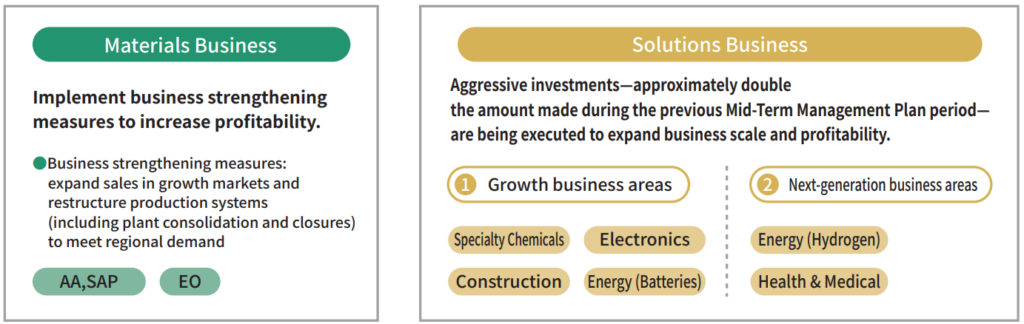
Materials Business
The Materials Business accounts for more than 70% of the Group’s revenue and provides products that support daily life worldwide. Stable procurement of raw materials and energy is essential, and this business accounts for the majority of the Group’s GHG emissions. The Group therefore continues to advance reduction measures at each site.
Solutions Business
Many products in this business are expected to contribute to solving environmental challenges, including GHG reduction. Under the Mid-Term Management Plan 2027 (p.16), the Group is promoting business development in Growth business areas that require technological innovation to address climate change.
Governance
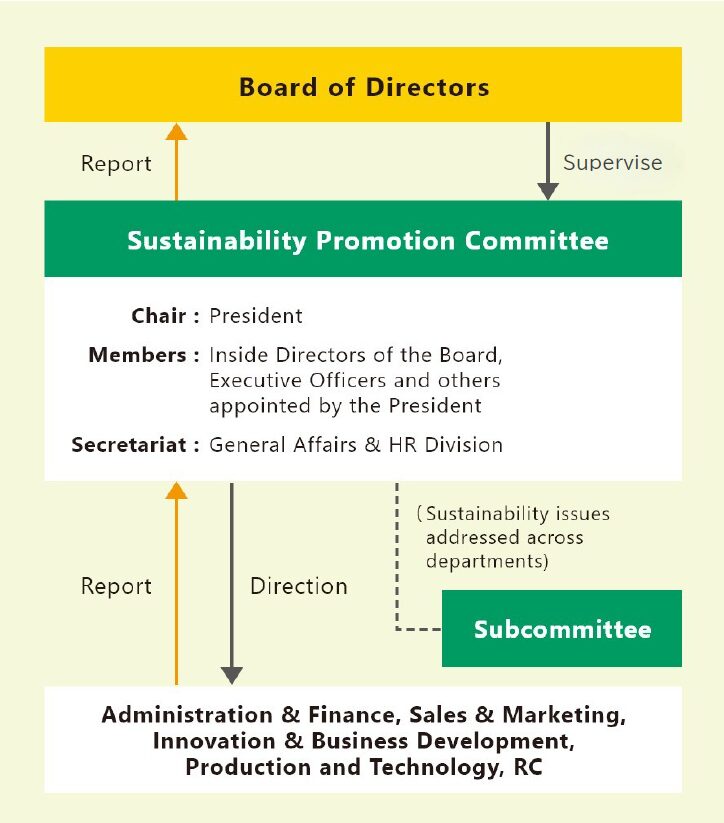
Management System for Promoting Sustainability
Sustainability Promotion Committee chaired by the president has been organized to implement sustainability initiatives, including climate-related initiatives.
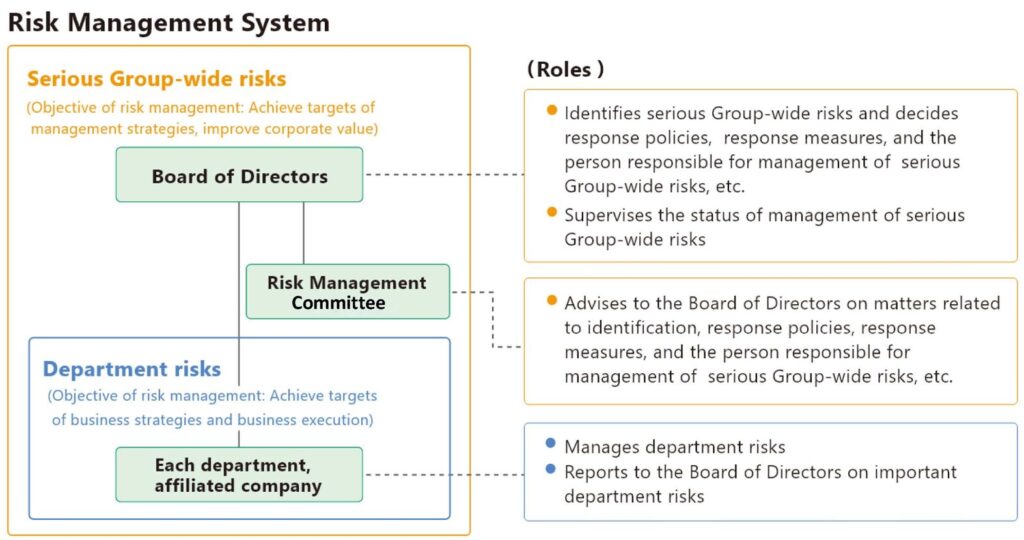
The Board of Directors reports, deliberates and resolves important matters related to business operations, and supervises the business operations of each Director of the Board. In addition, the Board of Directors identifies major Group risks, determines countermeasures and responsible leaders, and supervises overall risk management.
Roles of the Sustainability Promotion Committee
Determine Group’s policies and strategies relating to promote sustainability initiatives
Direct each department to formulate plans and measures and evaluate their performance and progress
Consider other significant matters relating to promote sustainability initiatives
Disseminate information about the initiatives to stakeholders
Role of Subcommittees
Subcommittees are established when cross-functional examination or planning is required for important sustainability matters, including climate-related initiatives.
Risk Management
Risk Management System
The Group classifies various internal and external risks that threaten the Group into “serious Group-wide risks” and “department risks,” and develops a risk management system appropriate for each risk category, thereby maintaining and improving our corporate value.
Climate change and human rights risks are recognized as material issues. Accordingly, the Sustainability Promotion Committee increases review frequency to ensure integrated and effective risk management.
Strategy
In the materiality review conducted in 2025, the Group has identified ‘Contribution to Solving Social Issues’ and ‘Promotion of Environmental Initiatives’ as key material issues within its materiality framework, and is advancing climate initiatives accordingly.
Contribution to solving social issues
The Group promotes the development and sale of products that contribute to reducing environmental impact, thereby achieving both business growth and resolution of social issues.
Promotion of environmental initiatives
The Group aims to achieve net zero for Scope 1 and Scope 2 by FY2050 and is promoting GHG reductions across the entire supply chain, including reducing product carbon footprints and advancing resource circulation.
In response to progressing climate change, the Group is strengthening water risk assessments and promoting the efficient use of water resources to ensure stable business operations.
Definition of Scenarios for Analysis
Prior to formulating initiatives, the Company developed two distinct scenarios for analysis to assess the impacts of climate change. These scenarios help identify risks and opportunities related to achieving future business strategies and sustaining current operations. Risks and opportunities are extracted through a cross-functional team involving senior management. The analysis scenarios were developed with reference to the Sixth Assessment Report of the Intergovernmental Panel on Climate Change (IPCC) and the IEA World Energy Outlook 2024.
Paris Agreement-Aligned Scenario (1.5–2°C pathway) Assumes strong technological innovation and financial mechanisms to limit global temperature increase to below 2°C and ideally 1.5°C. Time horizons: short-term to 2027, mid-term to 2030, long-term to 2050.
The time horizons applied in this scenario analysis are defined as follows Short term: up to 2027, aligned with the Group’s Mid-Term Management Plan period Medium term: up to 2030, aligned with the Group’s interim GHG emissions reduction target Long term: up to 2050, aligned with the Group’s net-zero target
Current Policies Scenario (approx. 4°C– pathway) Based on extensions of 2023 national policies. Climate Action Tracker (Nov 2024) projects an over 4°C rise by 2100.
STEP
Identification of External Environmental Changes
External environmental change factors were identified by reviewing disclosures by suppliers, industry peers, and customers (A), as well as ESG evaluation criteria.
STEP
Development of Scenarios for Analysis
Based on the recommendations of the TCFD, the Company developed company‑specific analysis scenarios (B) for use in its risk and opportunity analysis, with reference to climate-related scenarios published by the IEA, the IPCC, and other sources, while also taking into account the matters identified in (A).
STEP
Assessment of Business Impacts
Based on the analysis scenarios (B), business impacts were assessed, reflecting discussions held by the Sustainability Promotion Committee, relevant subcommittees, and deliberations related to the Mid‑Term Management Plan. → The results were reviewed and discussed by senior management.
STEP
Identification of Risks and Opportunities and Related Initiatives
Based on directions from the Sustainability Promotion Committee, initiatives are being implemented in line with the Company’s management plans and enterprise risk management framework.
Scenarios for Analysis
Scenario for Analysis 1: Achievement of the Paris Agreement Goals (1.5–2°C) (A scenario developed with reference to the IEA NZE 2050 and the IPCC SSP1‑1.9)
Political, Environmental, Social, Technological
■Natural Environment – Increase in extreme weather events and natural disasters (medium to long term) – Higher frequency of wind and flood damage – Ecosystem changes, with several percent of species facing extinction – Reduction of habitable areas, particularly in low-lying coastal regions
■Technology – Expansion of environmental technologies and accelerated use of digital technologies – Progress in renewable energy and energy-saving technologies – Accelerated innovation driven by digital technologies
■Society – Shift toward reduced consumption and stronger environmental orientation – Widespread adoption of product collection and reuse businesses – Aging populations in developed countries and population growth in developing countries
■Policy – Progress in climate change mitigation under international cooperation – Widespread adoption of carbon pricing mechanisms – Expansion of the circular economy (use of recycled materials) – Expansion of mandatory non-financial disclosures – Strengthening of environmental regulations
Value Chain Stakeholder Impacts
■Suppliers – Higher raw material and energy costs – Reduced supply stability – Stronger CSR sourcing and non-financial disclosure requirements
■Customers (B2B) / Markets – Demand for improved product carbon footprints – Requests for renewable energy and sustainable input – Increased participation in CSR/ESG procurement assessments – Expansion of renewable energy–related markets – Growing investment in low-carbon and environmental technologies
■Shareholders / Investors – Expansion of ESG investment products – Increased expectations for non-financial disclosure
Risks and Opportunities for the Group
Risks
Opportunities
– GHG emission costs under established carbon pricing – Higher procurement costs driven by strengthened climate policies – Delayed compliance with GHG regulations and non-financial disclosure requirements – Business impacts from changing market and customer requirements
– Wider adoption of renewable energy–related technologies – Increased investment in technologies to reduce environmental impact – Enhanced corporate credibility through appropriate non-financial disclosures – Operational improvements and solution offerings through digital technologies
Scenario for Analysis 2: Current Policies / Business-as-Usual Scenario (4°C–) (A scenario developed with reference to the IEA STEPS and the IPCC SSP5‑8.5.)
Political, Environmental, Social, Technological
■Natural Environment – Intensification of extreme weather events and natural disasters (medium to long term) – Sharp increase in species extinction, particularly in tropical regions – Reduction of habitable areas, mainly in coastal regions – Severe localized water scarcity
■Technology – Continued advancement in the use of digital technologies – Accelerated innovation driven by digital technologies
■Society – Limited shift toward reduced consumption and environmental awareness – Continued consumption of petrochemical-dependent products – Aging populations in developed countries and population growth in developing countries
■Policy – Carbon pricing limited to certain regions, creating trade distortions – Environmental regulations applied unevenly across regions
Value Chain Stakeholder Impacts
■Suppliers – Sustained demand and prices for fossil fuels and feedstocks – Higher water costs due to water scarcity – Facility damage from intensified natural disasters
■Customers (B2B) / Markets – Non-financial disclosure requests from selected customers – Slower growth of decarbonization-related markets
■Shareholders / Investors – Non-financial disclosure expectations concentrated in developed markets
Risks and Opportunities for the Group
Risks
Opportunities
– Limited delays in GHG regulation and disclosure compliance – Reduced returns on decarbonization investments – Facility damage and supply disruptions from extreme events – Regional constraints on water availability
– Enhanced credibility through non-financial disclosures – Growing demand for water production and desalination technologies – Process improvements through digital technologies
Risks and Opportunities
Impact Assessment and Initiatives for Risks (Transition Risks and Physical Risks)
For the identified risks, the Group assessed the underlying assumptions, impact magnitude, time horizon, and response measures.
Type
Category
Item
Underlying assumptions
Impact magnitude
Time horizon
Initiatives
Transition 1.5–2°C
Policy
GHG emission costs under established carbon pricing
– Higher product costs from the internalization of Scope 1 and Scope 2 emissions due to expanded carbon taxes and ETS*1
Low (medium term) High (long term)
Medium term and beyond
– Energy efficiency and process improvements aligned with the GHG reduction roadmap
– Evaluation of energy transition and CCUS options (long term)
– ISCC PLUS–certified biomass utilization
– Appropriate calculation and disclosure of product carbon footprints
Market
Business impacts from changing market and customer requirements
– Higher production costs driven by increased demand for renewable energy, sustainable feedstocks, and materials*2
Low (medium term) Medium (long term)
Policy
Higher procurement costs driven by strengthened climate policies
– Rising raw material and energy costs due to the introduction of carbon taxes and ETS*3
Low (medium term) Medium (long term)
Medium term and beyond
– Energy efficiency, renewable energy adoption, and use of credits
Policy
Delayed compliance with GHG regulations and non-financial disclosure requirements
– Business suspension or loss resulting from delayed compliance with regulations and disclosure requirements*4
Medium
Medium term
– Strengthened regulatory compliance and non-financial disclosure
Transition 4°C–
Market
Reduced returns on decarbonization investments
– Difficulty in recovering investments in growth business areas defined in the Mid-Term Management Plan 2027, including decarbonization-related technologies*5
Medium to High
Medium term and beyond
– Ongoing analysis of market trends and timely investment and exit decisions
Physical 4°C–
Natural Environment
Facility damage and supply disruptions from extreme events
– Site shutdowns due to flooding and storm surges Assumption of one-month operational shutdown to loss of site functionality*6
Medium to High
Long term
– Continued assessment of flood risk across the supply chain
Natural Environment
Regional constraints on water availability
– Temporary constraints on river water use due to drought and other factors*4
Medium
Long term
[Impact Magnitude] Low: 1 billion yen or more, Medium: 5 billion yen or more, High: 10 billion yen or more [Time Horizon] Short term: Corresponding mid-term management plan period (up to 3 years) , Medium term: Corresponding long-term vision period (up to 10 years) , Long term: Up to 2050
Long term: Assuming that a carbon price of 10,000 yen per t-CO2 is applied to the entire consolidated Scope 1 and Scope 2 emissions of 1,000 thousand tons in FY2024, resulting in an estimated impact of 10 billion yen.
Long term: Assuming that 260 thousand tons of consolidated purchased energy emissions (Scope 2) in FY2024 are electricity-related, and applying a carbon price of 10,000 yen per t-CO2, the estimated impact is approximately 2.5 billion yen.
Cost information is not disclosed due to its sensitive nature; however, based on FY2024 consolidated revenue of 244 billion yen and ordinary income of 17.7 billion yen, the estimated impact is considered to be at a medium level.
For example, consolidated revenue of NIPPON SHOKUBAI EUROPE N.V. (NSE) in FY2024 was 54 billion yen. (The standalone sales revenue information for NSE is based on data from Japan’s statutory Securities Report (Yukashoken-Hokokusho) issued on June 17, 2025.) A one-month business suspension would result in an estimated impact of approximately 5 billion yen.
Assuming that part of the related investments of 90 billion yen made during the period cannot be recovered.
Assumptions range from a one-month business suspension as described in (*4) to irreversible damage resulting in loss of site functionality.
Impact Assessment and initiatives for Opportunities
For the identified opportunities, the Group assessed the underlying assumptions, impact magnitude, time horizon, and initiatives.
Type
Category
Item
Underlying assumptions
Impact magnitude
Time horizon
Initiatives
Transition 1.5–2°C
Policy
Wider adoption of renewable energy–related technologies
– Profit indicators for batteries and hydrogen in the Mid-Term Management Plan 2027 (operating profit + equity-method investment gains)*1
Medium to High (profit indicator)
Short to Medium term
– Battery business expansion Short term: Capture strong demand growth in the Chinese market Medium term: Establish localized production aligned with local-for-local strategy (New facilities in Japan, capacity expansion in China, continued evaluation in North America) – Deployment of technologies supporting the hydrogen supply chain
Market
Increased investment in technologies to reduce environmental impact (Business)
– Profit indicators for water treatment and CO2 capture in the Mid-Term Management Plan 2027*2
Low to Medium (profit indicator)
Short to Medium term
Short term: Strengthen sales expansion in resilient water-related markets Medium term: Market expansion of related products aligned with growing demand for environmental impact reduction
Market
Increased investment in technologies to reduce environmental impact (R&D investment)
– To be validated through demonstration and deployment
―
Medium term and beyond
– Broader adoption of environmental contribution products – Development of biomass-based AA, SAP, and SAP recycling
Policy
Enhanced corporate credibility through appropriate non-financial disclosures
– Investment and financing opportunities driven by ESG and environmental ratings*3
Medium
Short to Medium term
– Improvement of major ESG ratings, including CDP – Establishment of systems to address future non-financial disclosure requirements
Technology
Operational improvements and solution offerings through digital technologies
To be validated through demonstration and deployment
―
Short to Medium term
– Productivity improvements and faster time-to-market through digital technologies in manufacturing sites and R&D
Transition 4°C–
Natural Environment
Growing demand for water production and desalination technologies
To be validated through demonstration and deployment
―
Medium term and beyond
– Addressing desalination needs in high water-risk regions (e.g., social implementation of forward osmosis desalination systems using draw solutions)
According to the Mid-Term Management Plan 2027 (p.14), operating profit related to energy and hydrogen, together with equity-method investment gains and losses, is included in the “Other” segment. Detailed segment-level numerical information is not disclosed due to its sensitive nature. The figures presented represent the differences between FY2030 and FY2024, and between FY2027 and FY2024 (7.3 billion yen by FY2027 and 16.8 billion yen by FY2030).
The same approach as in (*1) is applied to the “Specialty” segment, which includes water treatment and CO2 capture, with figures of 1.9 billion yen by FY2027 and 6.9 billion yen by FY2030.
Examples of actual achievements include subsidies from IONEL, financing from the Development Bank of Japan (4 billion yen), and grants aligned with national strategies (12 billion yen).
Metrics and Targets
Tackling Climate-related Risks
The Group formulated a roadmap for reducing GHG emissions by 2050 in terms of the “strategic trans-formation for environmental initiatives,” one of the “three transformations” set out in “TechnoAmenity for the future,” the Nippon Shokubai Group long-term vision published in April 2021.
Promotion of GHG Emissions Reduction from Business Activities
Starting in FY2025, the scope of GHG emissions reduction targets has been revised from covering Group companies in Japan only to covering the entire Group, including Group companies outside Japan. Through this revision, the Company is promoting GHG emissions reduction initiatives across the entire Group. As the Group’s aspired future state in responding to climate change, The Group aims to achieve net-zero Scope 1 and Scope 2 emissions by FY2050, and has set an interim target to reduce total Scope 1 and Scope 2 emissions by 30% by FY2030, compared with the base year and on a consolidated Group basis*.
*(In Japan) 30% reduction from FY2014 levels (Outside Japan) Reduction by [reduction objectives for each company] from [base year for each company] levels
Scope 1 emissions at Nippon Shokubai and its Group companies outside Japan that conduct manufacturing operations can be broadly divided into the following two categories:
– Emissions from fuel combustion for on-site energy generation and use, including cogeneration, and steam/heat production in boilers – Emissions resulting from chemical reactions in production processes
Initiative 1: Addressing Emissions from Fuel Combustion
The Group has largely transitioned the fuels used in cogeneration, boilers, and other stationary combustion to natural gas, achieving a significant reduction in GHG emissions compared with conventional fuels such as coal and heavy oil. Looking ahead, through collaboration with a wide range of companies and organizations, the Group will continue to examine the use of carbon-neutral fuels, including hydrogen, ammonia, and e-methane, as well as the application of carbon capture, utilization, and storage (CCUS) technologies.
Initiative 2: Addressing Emissions from Chemical Reactions
A significant portion of emissions from chemical reactions arises from catalytic oxidation reactions. Leveraging its core strength in catalyst technologies, Nippon Shokubai is continuously working to improve reaction efficiency, thereby reducing GHG emissions associated with chemical reactions. Through the application of advanced catalyst technologies and ongoing process optimization, the Group will continue to pursue sustained reductions in Scope 1 emissions derived from chemical reactions.
Efforts to Reduce Scope 2 Emissions
The Group is promoting energy efficiency measures and increasing the use of renewable energy to reduce Scope 2 emissions.
The Group is continuously implementing energy conservation activities at all manufacturing sites. The adoption of renewable energy varies by region and site. In North America and Indonesia, the renewable electricity share of purchased electricity has reached almost 100% through renewable electricity procurement. The Group will further expand the use of renewable energy at its sites in Japan and Europe. As of the end of FY2024, the renewable electricity share of purchased electricity for the Group was approximately 23%. Going forward, the Group will continue to expand renewable energy adoption in a phased manner across the Group while reviewing its energy portfolio.
[Assurance of Emissions Data Reliability] To ensure the reliability and accuracy of emissions data, the Company annually publishes emissions information that has been verified by an independent third party. Third-party Verification Report of FY2025 GHG emissions
Promoting GHG Emissions Reduction Across the Entire Supply Chain
Efforts to Reduce Scope 3 Emissions
Chemical products can affect the environment by consuming natural resources during production, emitting CO2, and generating waste. To address the challenges of climate change, it is essential to reduce GHG emissions and environmental impacts not only during the production of the Company’s products, but also across the entire supply chain, including the use and disposal stages.
Initiative 1: Utilization of Biomass-based Raw Materials
The Group is globally establishing a manufacturing and sales framework based on the mass balance approach, which combines biomass-based raw materials with petrochemical feedstocks, in anticipation of the phased expansion of the use of biomass-based raw materials. Currently, Group companies in Japan, Belgium, Indonesia, and the United States have obtained ISCC PLUS certification, thereby further expanding the supply of products with a reduced environmental impact. In parallel, the Group is also advancing the development of a biomass-based production process for acrylic acid, one of the Group’s core products, with the aim of achieving commercialization by 2030. Through these initiatives, the Group seeks to contribute to the reduction of Scope 3 emissions of its customers.
ISCC PLUS Certification Status
Country
Site
Certified Products
Link
Japan
Himeji Plant Kawasaki Plant
Acrylic acid, superabsorbent polymers, ethylene oxide and its derivatives.
Initiative 2: Development and Expansion of Environmental Contribution Products
The Group’s products are used throughout supply chains in a wide range of applications, including everyday products and social infrastructure. The Company assesses and reviews how these products contribute to reducing environmental impacts, including GHG emissions, and certifies qualifying products as Environmental Contribution Products. Revenue generated from Environmental Contribution Products is positioned as a materiality-related indicator for the Group, and is used to promote initiatives aimed at reducing environmental impacts.
* Certification is conducted by the internal certification committee based on checklists and quantitative data. Prior to certification, a third-party review is performed, and the views and advice obtained are incorporated into the examination materials used by the internal certification committee.
(billion yen)
FY2021 result
FY2022 result
FY2023 result
FY2024 result
FY2030 target
Sales revenue from Environmental Contribution Products (including Group companies)
39
44
45
47
135
Initiative 3: Estimation of Avoided Emissions Across the Supply Chain
The Company estimates the avoided emissions associated with Environmental Contribution Products that are expected to reduce CO2 emissions across the supply chain. For FY2024, the estimated avoided emissions amounted to 1,070 thousand t-CO2 per year.
Initiative 4: Calculation and Provision of Product Carbon Footprints (PCF)
To reduce GHG emissions across the entire supply chain, it is essential to accurately calculate and share GHG emissions at the product level. The Company has established an appropriate PCF calculation system by referencing domestic and international PCF standards and guidelines and provides PCF data to customers upon request. Going forward, The Company will continue to align with updates to relevant standards and guidelines and will work to reduce PCFs by reflecting its GHG emissions reduction initiatives in PCF calculations, thereby contributing to reductions in customers’ Scope 3 emissions.
Vision
Contributing to the reduction of GHG emissions throughout the supply chain
Initiatives
・ Enhancing product carbon footprint data quality ・ Sharing PCF information with stakeholders
KPI / Ideal state
Continuous improving calculation accuracy and reducing GHG emissions for each product through ongoing activities (achievement year: by FY2027)
Participation in Demand Response Contributing to the Stabilization of the Electricity Supply-Demand Balance
With the expansion of renewable energy sources, which are unstable in terms of power generation, increases the importance of balancing electricity supply and demand, the Himeji Plant of the Company has been participating in demand response since FY2021. When the supply-demand balance of electric power becomes tight, the Plant contributes to stabilizing the electricity supply-demand balance by reducing the amount of power received from the power grid, utilizing in-house power generation capacity in response to requests.
Contribution to Resource Circulation
Resource circulation is a critically important initiative, not only from the perspective of preventing the depletion of important resources and reducing dependence on specific resources, but also as part of efforts to mitigate climate change.
The Group stipulates the following in its Environmental Protection Policy
Reduce emissions of waste and chemical substances and promote the recycling and the effective use of resources including water resources to contribute to the realization of a Sound Material-Cycle Society.
Actively seek to develop and provide products and technologies that help reduce environmental impact.
Based on this policy, the Company is systematically promoting resource circulation and waste reduction.
Contribution to Resource Circulation
Initiative : Reduction of Waste and Promotion of Recycling
In its production activities, the Company aims to contribute to resource circulation by achieving a state in which the generation of industrial waste is reduced and the waste is effectively utilized as resources and energy sources. Specifically, the Company is advancing initiatives toward the following targets.
Vision
Minimizing waste generation and effectively utilizing it as resources and energy
Initiatives
・ Waste reduction ・ Promotion of recycling
KPI / Ideal state
・ Quantity of final off-site landfills: maintaining zero emissions(1) (achievement year for Nippon Shokubai alone: by FY2027) ・ Waste plastic emissions: 50% reduction in emissions from FY2021 level (achievement year for Nippon Shokubai alone: by FY2030)
(1) (Quantity of final off-site landfill) ≤ (total amount of waste generated x 0.1%)
Conservation and Efficient Use of Water Resources
For the Group, water is an essential resource for the manufacture of chemical products, and ensuring its sustainable availability is a critical management issue directly linked to business continuity and medium- to long-term corporate value.
Conservation and Efficient Use of Water Resources
Initiative : Assessment of Water-related Risks
From the perspective of climate change adaptation, water-related risks associated with extreme weather events caused by global warming, such as storm surges, flooding, and droughts, are of particular concern. The Company focuses on risks related to water procurement and assesses the potential for its production sites to be located in areas of high water stress, using the Aqueduct Water Risk Atlas provided by the World Resources Institute (WRI). In addition, with the aim of conserving water resources and promoting their efficient use, the Company will continue to conduct water-related risk assessments and promote efficient water use to achieve a state in which harmony between water resource security and water use in business activities is maintained.
Vision
Maintaining harmony between water resource security and water use in business activities
Initiatives
Risk assessment and promotion of efficient use of water resources
KPI / Ideal state
Continuous monitoring of water risks (stress) and actions based on assessment results (achievement year: by FY2027)
Addressing Climate-related Opportunities
Addressing Climate-related Opportunities
Initiative 1: Promotion of Renewable Energy-related Technologies
In the short to medium term, the adoption of electric vehicles (EVs) is accelerating worldwide. In the long term, the use of hydrogen energy is expected to expand across regions as part of the transition away from fossil fuels. The Group will respond swiftly to these market expansions and the energy transition, and make proactive investments to support the dissemination and development of renewable energy-related technologies.
Initiative 2: Expansion of Investments in Technologies to Reduce Environmental Impacts (e.g., Water Treatment and CO₂ Capture)
Water scarcity and water pollution resulting from climate change are critical challenges facing the global community, regardless of country or region. In addition, technologies that capture and remove carbon dioxide (CO2), a primary driver of climate change, are becoming increasingly important in the transition to a decarbonized society, and are expected to experience rapid market growth in the coming years. By accurately identifying these market growth opportunities and related transitions, the Group will respond swiftly and make proactive investments.
Initiative 3: Improvement of Production Technologies and Solution Proposals through the Use of Digital Technologies
At the Kawasaki Plant of the Company, an advanced process control system introduced at the Ukishima Plant was expanded to the Chidori Plant, and operating patterns of production facilities were optimized in accordance with production volumes. As a result, in FY2024, the Kawasaki Plant achieved energy savings of approximately 3,200 kL (crude oil equivalent) and reduced CO2 emissions by approximately 7,500 t-CO2. In addition, productivity improved, leading to a reduction in variable costs. Going forward, the Group will continue to expand the application of the advanced control system and further promote energy conservation.
Initiative 4: Promotion of Appropriate Regulatory Compliance and Disclosure of Non-financial Information
To clearly communicate the Group’s medium- to long-term initiatives for value creation to all stakeholders, including shareholders and investors, the Company publishes an Integrated Report (the “TechnoAmenity Report”), which provides a wide range of information, including materiality, the value creation process, business strategy, governance, and financial information.
Through appropriate and transparent disclosure, the Company aims to maintain its inclusion in major indices (including ESG indices) and to further broaden such inclusion. The Company also reflects the results of external ESG evaluations in its continuous improvement activities.
The Group has introduced an ICP system to raise decarbonization awareness across the Group, accelerate energy-saving initiatives, and facilitate more active evaluation of business opportunities and risks associated with CO2 emissions reductions.
Outline of ICP
ICP
10,000 yen/t-CO2 Shadow price set with reference to domestic and international carbon prices.
Method of application
The costs will be calculated using ICP based on a change of CO2 emissions and used as a criterion for investment decisions.
Range of application
Nippon Shokubai Group
GHG Scope
Scope 1 and Scope 2
Updated Contents
April 2026: Comprehensive revision based on the medium-term management plan and materiality formulated in 2025.
Please see here for past Disclosure Based on TCFD Recommendations.